Development Woes - The Bug That Wasn’t
 As many know, development of any platform, or even a smaller wrapper application, always comes with at least one challenge. However, the ones that tend to be the most memorable are the ones that caused the biggest headaches, enabled Panic Mode, only to have a surprisingly simple resolution. For us, that is exactly what happened on Friday.
We were testing a rather large build involving a major structural change as part of our Pre-Beta changeover when AE CoCast suddenly developed what looked like a serious networking failure. Sessions were still being created normally, participants could connect, and the application itself appeared healthy.
But the media path had stopped working. At first glance, everything pointed toward a new regression somewhere in the recent development work. So we did what developers do.
We started looking for the bug.
When Everything Points to the Code
The timing certainly did not help. We had just made a significant structural change, so naturally our first assumption was that something in the new build had gone wrong. Recent changes were reviewed, networking behavior was checked, and we started working our way through the possibilities.
The particularly frustrating part was that much of CoCast continued behaving normally. The application was connecting, sessions were being established, and everything appeared to be communicating as expected. Yet the part that actually mattered for the test, getting the media from one participant to another, simply was not happening.
That is the kind of failure that can send developers down a rather deep rabbit hole very quickly. So, before tearing apart too much of the new work, we went back to something we already knew worked. We pulled out an older, previously tested build and ran the same test again.
It failed too.
And suddenly, the bug hunt became considerably more interesting.
Looking in the Wrong Place
 Once the older build failed in exactly the same way, the likelihood of a new client regression dropped considerably. That did not immediately tell us what the problem was, but it told us something equally useful: we were probably looking in the wrong place. The investigation shifted away from the client and toward the environment around it.
That meant looking at the systems supporting the application rather than the application itself. The server was online. Sessions were still being created. Connections were being established. From a high level, everything looked normal. Which, of course, made the problem more annoying.
The failure was not dramatic enough to take the whole system down. Instead, just enough of the environment was working to make the application appear healthy while one important part of the networking path quietly failed underneath it.
Eventually, the common factor became clear. The server had recently been rebuilt and restarted as part of routine development work.
And that is where our “bug” was hiding.
The Server Was Fine. Mostly.
Nothing was wrong with the new build.
Nothing had broken in the client.
The networking changes we had been reviewing were not the culprit either.
One step in the server startup process had simply been missed.
That small omission meant part of the environment required for media transport had not been loaded correctly. The server itself was running and responding, which is why the problem was so convincing. Enough of the system was operational to make it look like the application had developed a very specific transport failure.
Once the server was restarted through the proper process, everything came back.
Media began flowing again. The test environment behaved normally. The suspected regression disappeared.
No rollback was required.
No emergency rewrite.
No mysterious flaw buried deep inside the new architecture.
Just one missed operational step.
... Oops.
The Value of a Known-Good Build
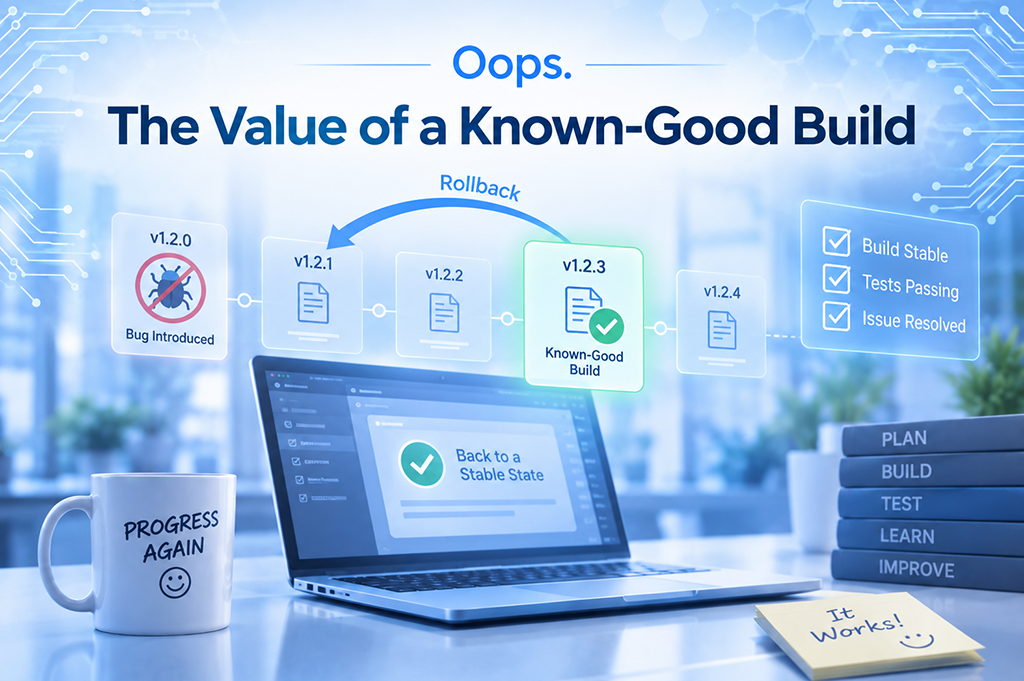 The most useful part of the entire investigation was probably the simplest thing we did: testing an older build. Without that comparison, it would have been very easy to keep digging through recent changes because the timing made them look guilty. A known-good build gave us a clean control.
When that build failed too, we had a much stronger reason to stop blaming the current client and start looking elsewhere.
That kind of comparison is not particularly exciting, but it is one of those development habits that can save a lot of unnecessary work. Sometimes the fastest way to diagnose a new problem is not to keep staring at what changed, but to test something that did not.
Not Every Bug Is a Bug
Software development has a way of reminding you that failures do not always live where the symptoms appear. Sometimes the problem is in the code. Sometimes it is the network. Sometimes it is configuration, deployment, environment, permissions, or a service that is technically running but not quite running the way you think it is.
And sometimes someone rebuilding a server simply forgets one step.
The important part is having enough visibility into the system to tell the difference, and enough patience to keep eliminating possibilities before changing code that may already be working exactly as intended. This one caused a few headaches, enabled Panic Mode for a bit, and sent us down a respectable debugging rabbit hole.
In the end, though, the resolution was much simpler than the symptoms suggested.
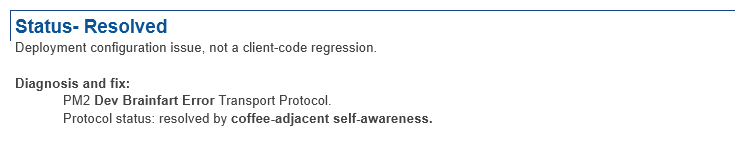
Our internal final status probably summarized the entire episode best: