What We Learned in 2025: Cloud, AI, and the New Era of Real Time Development
 2025 has been a year of rebuilding, refocusing, and steady acceleration. For teams working in 3D interactive development, simulation, and real time collaboration, this year reinforced how rapidly the landscape is evolving. It also confirmed that the direction we set for Apex Engine is aligned with where the industry is heading.
From NVIDIA GTC DC to AWS infrastructure updates and the broader shift toward cloud-native systems, the trends that emerged this year shaped our decisions, our priorities, and the foundational work we strengthened throughout the fall.
Here are the key lessons that defined our work in 2025.
1. Cloud is the backbone of modern development
Every major event this year underscored the same point. The future of development is cloud-native. Teams want real time collaboration, shared environments, and scalable systems without hardware limits.
Apex Engine was designed with this in mind from the beginning. The conversations and validation throughout 2025 reinforced that direction.
2. Real time collaboration is now required, not optional
Remote and hybrid teams have become standard across gaming, education, simulation, smart cities, and enterprise. Real time editing and multi-user workflows are no longer seen as early innovations. They are now fundamental platform requirements.
Our work on Apex Hub, authentication, backend security reviews, and interface refinements reflects this shift. The industry is asking for the exact type of infrastructure we have built for years.
3. AI is becoming part of the engine ecosystem itself
 One of the strongest themes in 2025 across NVIDIA, AWS, and local innovation circles was how AI is moving inside the development environment rather than sitting outside it.
AI is reshaping:
• Code completion and debugging
• Procedural content generation
• Physics and simulation tuning
• Scene analysis and validation
• Digital twin automation
This year confirmed that the AI vision we have set for Apex Engine is on the correct trajectory.
4. Simulation and digital twins continue to expand across industries
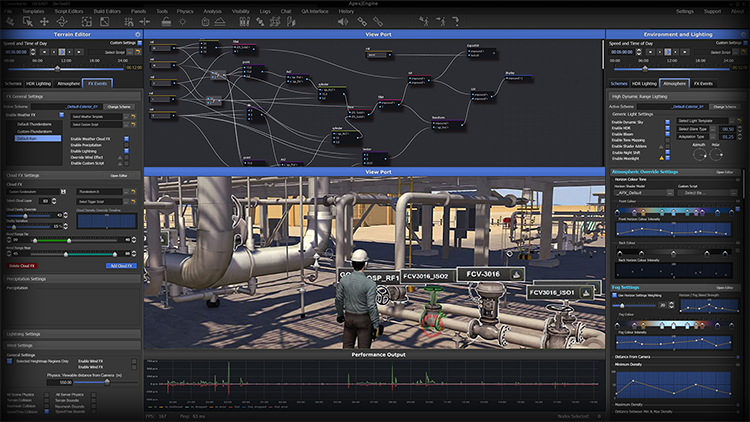
Cities, research labs, medical teams, enterprise operations, and infrastructure groups increased their interest in real time simulation environments. IoT integration, remote monitoring, and predictive modeling are growing quickly.
Our physics integrations, internal simulation editor planning, and Legacy platform preparation align directly with this continued demand.
5. Security and infrastructure matter
One of the clearest lessons of 2025 was the importance of proactive security, not just for our own systems, but for our clients and partners as well. Following the external account intrusions and the GoDaddy incidents, we invested significant time hardening authentication, recovery workflows, access controls, and internal operational processes.
This work is not flashy, but it protects everything layered on top of the engine. It directly supports Apex Hub, HeroEngine Legacy activation, and the next stage of community onboarding by ensuring that growth does not come at the expense of security, privacy, or operational integrity.
 6. Community shapes our real priorities
Tech Week events, GTC DC, and local innovation meetups brought important insights from engineers, founders, and researchers. These conversations helped refine investor messaging, shape our development decisions, and influence how we structured our November work.
Just as importantly, feedback from our clients and early community continues to ground those decisions in real-world use, not assumptions. Their needs, constraints, and long-term goals help keep Apex Engine focused on solving problems that actually matter.
Engagement remains one of the strongest forces in guiding real long-term direction.
7. Flexibility and resilience remain essential
If 2025 taught us anything, it is that even the best planned roadmap needs flexibility. Account complications, infrastructure requirements, and shifting investor cycles all required careful adjustments.
This year reinforced how important it is to maintain a strong foundation while adapting to new conditions.
8. Physics testing reinforced
One of the quieter but important areas of work in 2025 was direct testing and evaluation between NVIDIA PhysX and Havok. The goal was not to declare a winner, but to validate assumptions around cross-platform behavior, determinism, and long-term engine architecture.
What we learned through testing was straightforward. Modern engines must treat physics as a backend system that is portable, predictable, and decoupled from rendering and hardware assumptions. CPU-based physics paths remain the most reliable option when targeting Windows, Linux, and Apple platforms simultaneously, especially in cloud and collaborative environments.
PhysX continues to be viable when used in a CPU-first configuration, with GPU acceleration treated as an optional optimization rather than a dependency. Havok demonstrated strong consistency and stability across platforms, reinforcing why many large studios favor it for long-lived projects and simulation-heavy workloads.
The key takeaway was not about features, but about strategy. Physics systems need to support:
- Deterministic behavior across platforms
- Headless and server-side execution
- Cloud scaling and simulation workloads
- Long-term maintainability without vendor lock-in
This testing reinforced our approach of designing Apex Engine with a pluggable physics architecture. It allows us to support different backends while preserving consistent behavior for real time collaboration, simulation, and multi-user environments.
Looking ahead
2025 has prepared us well for what comes next. The investment in cloud infrastructure, AI-supported development, real time collaboration tools, physics and simulation work, and stronger security puts us in a solid position for the new year.
Our goals remain focused on platform stability, multi-industry capability, and a real time development ecosystem that grows with creators, researchers, and enterprise teams. We expect 2026 to be the year these foundations begin to accelerate.