Part One: The Foundation Was Never the Problem
What Data Centers Were, What They Became, and Why It Matters Now
 Why are data centers suddenly generating noise complaints, air quality concerns, and rising utility bills across residential communities, when they have operated quietly beside those same communities for decades?
The facilities at the center of these complaints are not a new technology deployed without a proven alternative. The engineering discipline required to build them responsibly is not theoretical. It is documented, operational, and running at hyperscale in those same states right now. The solution has existed for more than thirty years. Properly built data centers are not a burden to their surrounding communities. They are invisible to them.
So what changed?
The Industry Did Not Start in Silence
Long before data centers existed as a category, the telecommunications industry had already solved the problem of containing industrial-scale noise inside purpose-built structures.
The Bell System’s electromechanical era did not begin without precedent. Before mechanical switching existed, telephone calls were connected by hand. Operators, predominantly women, sat at manual switchboards physically routing each call by plugging cables into the correct jacks and pulling them when the call ended. It was skilled, demanding work, and it scaled only as fast as the human workforce could grow. As residential telephone adoption accelerated through the mid-twentieth century, the volume of calls being placed each day outpaced what any workforce could physically manage. The solution was automation.
The transition from manual operator switching to automatic electromechanical systems, beginning with Strowger step-by-step switches and evolving into crossbar systems through the 1950s and 1960s, fundamentally changed what a telephone central office was. It went from a room full of people to a room full of machines. And machines at that scale, thousands of mechanical relays, selectors and connectors clicking and engaging continuously across every active call simultaneously, produced noise at an entirely different order of magnitude than the hum of a staffed switchboard ever had.
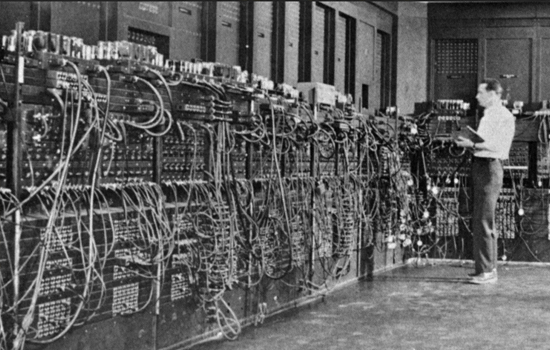 The Bell System began building large-scale electromechanical central offices in the 1960s, with early installations in New York and Michigan among the first of their kind. The buildings constructed to house that transition had to contain something the earlier facilities never faced. In Dearborn, Michigan the LO exchange, named for Lorrien Street just off Michigan Avenue where the equipment sat, was significant enough during that transition period that the community kept its alpha prefix rather than converting immediately to the full numeric 561 designation. Local businesses were still printing LO1 in their newspaper advertisements through the mid-1970s, long after the infrastructure underneath had moved on. The familiarity of the exchange name outlasted the technology that created it.
Boomers and late Gen Xers will remember dialing those alpha prefixes. Younger readers may find it interesting that the letters on a rotary dial had nothing to do with texting. They were the user interface for a geographic routing system, and communities held onto them long after the machines made them unnecessary.
The demand driving that buildout was not a single factor. It was a convergence. Named local telephone exchanges, the LOcust, MUrray, and TUlip prefixes that gave households numbers like LO1-5767, were being retired and converted to all-numeric dialing as subscriber volumes outgrew what the older exchange architecture could support.
Simultaneously, party lines, the shared telephone numbers that had been a fixture of residential service for decades, were being phased out in favor of dedicated individual lines. Urban and suburban markets completed that transition primarily by the mid-1980s, with rural cooperative networks following through the late 1980s. Every retired party line became two, three, or four dedicated lines requiring individual switching capacity. The infrastructure had to scale to meet that demand, and scale it did.
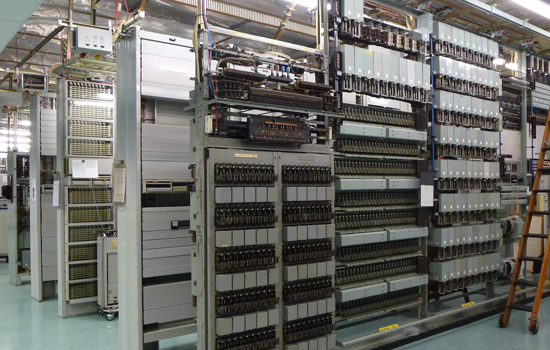
The central offices and switching stations built through the 1960s, 1970s, and into the 1980s housed some of the loudest continuous mechanical environments in commercial infrastructure. Rows of electromechanical switching panels twelve to fourteen feet tall filled floor after floor, clicking, clacking, and humming at levels that required workers to wear hearing protection before entering designated equipment areas.
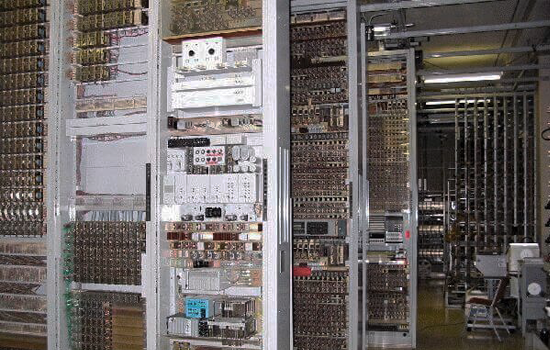 Federal OSHA standards mandate hearing conservation programs at 85 decibels sustained over an eight-hour workday and prohibit unprotected exposure above 115 decibels. Transfer rooms and converter rooms in these facilities operated well within that upper range. The physical harmonic hum from basement power conversion equipment was felt in the body before it was heard by the ear.
From the street outside, those buildings looked like warehouses.
That was not accidental. It was engineered. The structural and acoustic containment required to keep that level of mechanical and electrical noise invisible to surrounding neighborhoods was a deliberate design discipline applied as a non-negotiable baseline requirement. Not a premium feature. Not an afterthought. A prerequisite.
The Discipline Carried Forward
When commercial data centers began emerging in the early 1990s, they inherited that engineering lineage. The facilities were quieter internally than their telco predecessors. Raised floor plenum cooling, hot aisle and cold aisle containment, computer room air conditioning units, and acoustically engineered structural envelopes replaced the electromechanical switching arrays of the Bell System era. The noise profile changed. The containment discipline did not.
Through the dot-com surge of the mid-1990s and into the early 2000s, purpose-built commercial data centers became a distinct infrastructure category. Facilities were sited industrially, permitted as the industrial operations they were, and engineered from the foundation up to contain heat, noise, and emissions within their structural envelope. The surrounding communities rarely knew they were there.
That was the standard. Not aspirational. Operational.
Scale Did Not Break the Model
 One of the most persistent misconceptions about the current data center situation is that noise, pollution, and community cost impacts are an inevitable consequence of scale. That larger facilities are inherently louder, more disruptive, and more difficult to contain. The evidence does not support that conclusion.
Cogent Communications operated a facility at 510 Huntmar Park Drive in Herndon, Virginia that traces its origins to 1989. Built at the earliest edge of the commercial data center era, it carried forward the structural discipline of the telco infrastructure that preceded it. Decades of continuous operation in a Fairfax County residential corridor without noise complaints, air quality concerns, or community opposition.
AWS us-east-1, launched in Northern Virginia in 2006, is Amazon’s oldest and largest cloud region. Nearly twenty years later it encompasses six availability zones and 187 facilities across the Northern Virginia corridor. It runs artificial intelligence workloads today. The neighborhoods around it are not filing noise complaints, appearing in senate testimony, or seeing their utility bills triple.
AWS us-east-2, launched in Ohio in 2016, operates on an even larger campus footprint. Multiple data center campuses span thousands of acres across Licking County and Franklin County, with individual structures exceeding one million square feet of floor space and 500 megawatts of known IT capacity. It is one of the largest AWS infrastructure concentrations in the United States. It is also, from the street, unremarkable.
Alibaba Cloud operates its US East region in Northern Virginia. Most people who drive past its campus assume they are looking at a large warehouse complex. They are not. They are looking at a globally significant cloud infrastructure deployment operating quietly in plain sight, indistinguishable from its surroundings by design.
Three providers. Three eras spanning 1989 to the present. Three entirely different corporate origins across two continents. One consistent outcome. When engineering standards and regulatory oversight are applied before construction begins, data centers are good neighbors. Full stop.
The Assumed Urgency
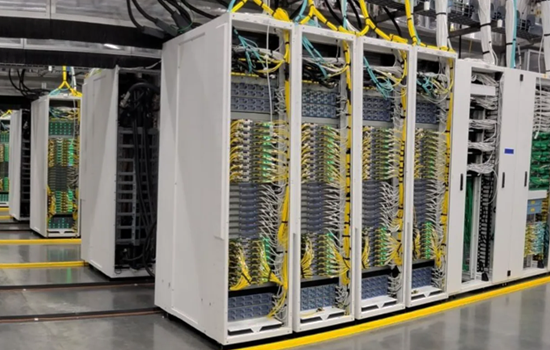 The narrative justifying the current wave of fast-built, inadequately engineered data center installations centers on demand. Artificial intelligence is growing at an unprecedented rate. Compute capacity must scale immediately to meet it. Speed is a necessity, not a choice.
That narrative deserves scrutiny.
AI compute efficiency is advancing rapidly. The emergence of optimized training and inference architectures, demonstrated most visibly by Chinese developers with DeepSeek and now being pursued by leading American developers and hardware manufacturers, has shown that dramatic reductions in compute cost are achievable through architectural innovation rather than raw capacity expansion. Runtime costs across major cloud providers have dropped significantly as these optimizations take hold.
Yet customer pricing has not followed that trajectory. AWS RDS pricing has risen nearly three times over the past three years despite runtime cost reductions of fifty to sixty percent depending on database engine, with PostgreSQL and comparable open architectures seeing reductions approaching eighty percent. The capacity being built today is sized for a demand model that optimization is already rendering obsolete.
The gap between falling runtime costs, rising customer prices, and expanding quarterly margins is documented in public earnings reports. It is not a coincidence. It is a business decision. And the communities absorbing noise, air quality impacts, and utility rate increases are not subsidizing a technical necessity. They are absorbing the external costs of a capacity buildout whose primary beneficiary is margin, not progress.
The Variable Was Never the Technology
The engineering knowledge required to build data centers that are acoustically contained, environmentally responsible, and invisible to surrounding communities is not theoretical. It is proven across three decades, three corporate origins, and facilities ranging from a 1989 Herndon colocation site to a million-square-foot Ohio campus running AI workloads today.
What the evidence does not support is the conclusion that the current situation was inevitable. The discipline existed. The standards existed. The examples of correct implementation exist and are operating right now in the same states where communities are filing complaints.
What changed was not the technology, and it was not directly the demand. So what changed?
Part Two examines the artificial intelligence demand inflection, the grid capacity crisis it exposed, and the business decisions that followed when urgency became the justification for bypassing the standards that kept this industry a good neighbor for thirty years.
Are you seeing changes in your utility bills or noise levels near a data center facility in your community?